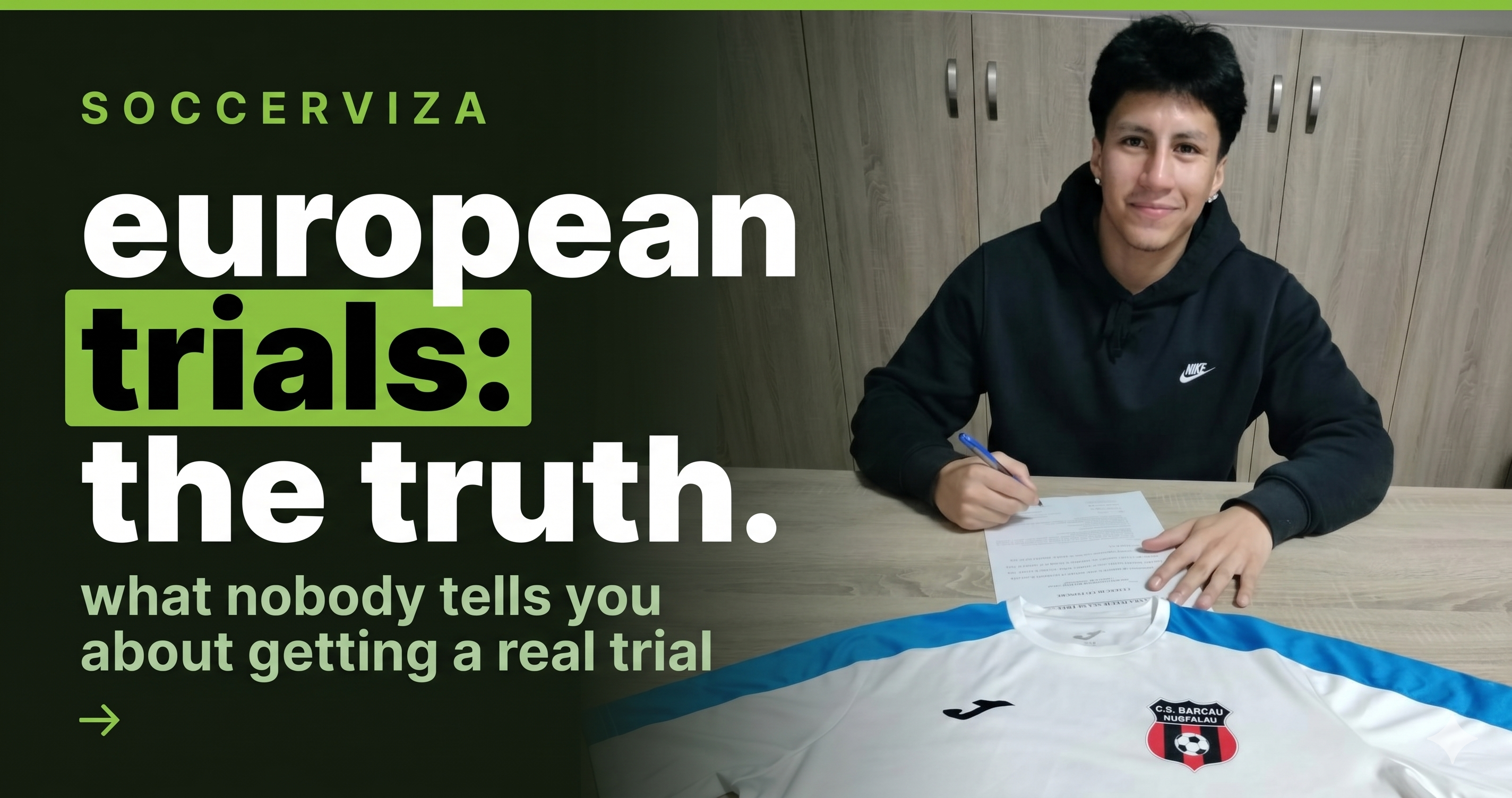
The Hook: Most European Trials Are Glorified Scams
Most "European soccer trials" are glorified showcases that charge $3,000-5,000 and have zero real club connections. Players come home with nothing but a lighter wallet. But real European trials do exist — and understanding the difference could save you years and thousands of dollars.
What Is a Real European Soccer Trial?
A real trial means a club is evaluating you for a potential contract. But here's what nobody tells you: most of the time, YOU are paying for your housing and food during a trial. The club doesn't know you — they're not dipping into their budget for an unknown player. If they sign you, they might reimburse you. But they might not.
You don't have a name yet. You don't have the luxury to negotiate. You go out there, show you're worth it, and build a name. In your first few years as a no-name player, your salary means nothing. You need housing and food — that's about it. You have to grind and make a name for yourself.
The Reality: European trials are not vacation opportunities. Clubs want to see whether you can impact their team. They're not interested in your technical ability in isolation — they want to know if you're better than the local player you're replacing.
Why Most Players Get Scammed
The showcase/tour industry profits from hope. Red flags are everywhere. Guaranteed contracts that come from "trial tours." Pay-to-play programs with no named clubs. "Scouts attend" promises with no names listed. Short trips with zero follow-up after you go home.
Here's what separates legitimate programs from theater: the people running them actually understand the industry and can teach you about your career — not just put you through training sessions. Many programs claim to put you in front of scouts who aren't even looking for players. It's performance art, not professional development.
When you're evaluating a program, ask yourself: Do the people running this understand visa laws? Do they know the foreign player restrictions in each league? Can they teach you about contracts, salary expectations, and realistic options? Or are they just running you through drills and hoping a scout shows up?
A real program educates you. That's the difference.
Let's Talk About Money — Because Nobody Else Will
Here's the honest truth that most programs dance around: to get in front of the right people, to learn what you need to learn, and to put yourself in a position where clubs can actually see you — you're going to need to spend money.
Flights. Housing. Food. Training. Trials that go nowhere. Trials that go somewhere. It all costs money. And if you're scared to invest in your own dream, you have to ask yourself how badly you actually want this.
We're not going to pretend this path is free. It's not. The difference is what you're investing in. Are you paying $3,000 for a one-week tour where you take a group photo with a scout who isn't looking for players? Or are you investing in people who understand the industry, who teach you the business of football, and who put their reputation on the line every time they connect you with a club?
One is a vacation disguised as an opportunity. The other is a professional investment in your career.
If you're not willing to invest in yourself, nobody else is going to invest in you. That's professional football. Clubs aren't spending their budget on a player they've never heard of. You have to go out there, spend your own money, prove you're worth it, and build a name. The players who make it understood that from day one. The ones who didn't make it were waiting for someone else to foot the bill.
The Reality Check: Every professional player we've worked with invested in their own journey before anyone invested in them. That's not a sales pitch — that's 14 years of watching who makes it and who doesn't. The ones who are afraid to lose money chasing this dream? They usually don't love it enough.
How to Actually Get a European Trial
Build a Highlight Reel That Actually Opens Doors
You definitely need one to market yourself. But here's the thing: it MUST impress in the first 30 seconds or it's useless. Clubs are not watching five-minute videos of you jogging around the field. They're watching the first 30 seconds.
What should be in it? Impact. Show what makes you different. Show how you change the game. Show what you bring to the team. A lot of players put simple passes and movements in their highlight reel — that's NOT a highlight. Show IMPACT. A goal. An assist. A defensive recovery that changes possession. A run that creates space. Something that makes a coach say "okay, this player matters."
The reel is a door opener, not a guarantee. But without a good one, you don't even get through the door.
Learn How to Network (Most Players Don't Know How)
Your highlight reel can get you in the door, but you also have to open doors through networking. Most players don't know how to properly network in the football industry. This is a skill that has to be taught — something we teach at SoccerViza.
You need to be putting yourself out there constantly. Getting proper exposure means spending money — flights, hotels, food, trial fees. Sometimes the trials aren't good. That's part of the process. You're not going to hit it off with every club. You might spend $3,000 on a trial that goes nowhere. That's the cost of finding the one that works.
Find a Development Program You Can Actually Trust
There are many development centers. The difference is the people running them. When you speak to staff, do they understand the industry? Can they teach you about your career? A real program teaches contracts, visa process, what clubs expect, realistic options. That education separates legitimate programs from glorified training camps.
Surround yourself with like-minded people. If nobody on your local team wants to go pro, you're not getting better. You need to be in an environment where the standard is high and everyone is chasing the same thing.
Getting Trial Opportunities (And How They Actually Work)
Trials come from multiple sources: paid events, personal networking, mutual contacts, program relationships. For players we work with, we either teach them to create their own trials or we set it up between club and player.
When a club is in our trusted network, we know the player will be taken care of. When SoccerViza puts its name on the line and the club pays for housing/food, we have to be sure — because if the player doesn't perform, the club loses money and our reputation takes a hit.
Visa laws differ from league to league, division to division, country to country — you need extensive research for each specific market. You can't just say "these countries are the best" — you have to know them specifically. EU passport? Massive advantage. Non-EU player? Work permit requirements vary wildly. Some countries want players to have played professional already. Others will give young players a chance. You have to do the homework.
What Happens When You Get a Trial
A trial typically lasts 1-3 weeks. You train with the club's squad. You play in friendlies or reserve matches. The club is watching one thing: can you IMPACT the game? You're taking a foreign spot. You have to be better than the local.
It's not about technique or looking the part. Can you perform? Can you change the game from your position? Professional football outside America is results-driven and cutthroat. You do your job or someone else will.
Not Sure Where to Start?
We've helped 400+ players navigate this exact process. Book a free career consultation — no pressure, no commitment.
Book Your Free Call →Real Players Who Got European Trials Through SoccerViza
These aren't theoretical examples. These are real SoccerViza alumni who got actual trials and signed contracts.
These players didn't get trials by sitting at home and sending emails. They put themselves in a professional environment, they networked, they were seen by the right people, and they performed when it mattered.
It's Not Just Europe — The World Is Bigger Than You Think
Most players fixate on Europe because that's what they've been told to chase. The big five leagues. The Champions League dream. And look — Europe has real opportunities. But it's not the only market, and for a lot of players, it's not even the best market.
SoccerViza has placed players in 30+ countries. Some of the best career paths we've seen started in markets nobody was talking about — Central America, Southeast Asia, the Nordic countries, South America. Players who went to these markets first built their names, got professional experience, and then leveraged that into bigger moves later.
Darwin Lom didn't stay in Portugal. His career took him through Guatemala, Bolivia, and the USL. Zac Lubin started in Iceland, moved to Sweden, then came back and dominated in the USL Championship. The path isn't a straight line to one country. It's a career that moves across borders as you grow and your market value increases.
But here's the thing — every market is different. Every country has different visa laws, foreign player restrictions, salary structures, and cultural realities. You can't just Google "best countries to play soccer" and book a flight. You need to understand each market specifically. That takes research, connections, and people who've actually navigated these systems before.
The opportunity is global. But the preparation has to be specific. That's what most players miss.
The Bottom Line
Getting a professional trial — whether in Europe, Central America, Asia, or anywhere else — is real. But it's not what most programs are selling you. The showcase industry profits from your hope. A real trial requires a roadmap — understanding visa laws, foreign player restrictions, what clubs actually want, and how to position yourself in a market where you're an unknown.
It's going to cost you money. It's going to be uncomfortable. And signing a contract is the starting line, not the finish line. If you're not willing to invest in yourself, nobody else will. But if you're ready to grind, learn the industry, and put yourself out there every single day — the opportunity is there. We've seen it hundreds of times across 30+ countries.
FAQ: European Soccer Trials
How much does a European soccer trial cost?
YOU often pay your own way — flights, housing, food. Budget $2,000-5,000 minimum. If a program charges $3,000+ for a "trial tour," ask hard questions about club connections and industry understanding.
How long is a typical soccer trial in Europe?
1-3 weeks typically. Some clubs decide in days. It depends on the club's evaluation period and how quickly they assess fit.
Do I need an agent to get a trial?
Not necessarily. Networking, development programs, and direct club relationships can get you there. An agent helps AFTER you've proven yourself and have market value.
What visa do I need to play soccer in Europe?
Every country is different. EU passport holders have a massive advantage. Non-EU players face work permit requirements that vary by country and league. This is why you need to research each market specifically.
Can I get a trial without playing D1 college soccer?
Yes. Division doesn't matter. We've placed D3, D2, NAIA, and non-college players. What matters is whether you can impact the game at the level the club needs.